Showing posts with label Google. Show all posts

Monday, October 31, 2011

Google is Becoming Microsoft Starting with the New Google Reader

Google updated their Google Reader interface today, and I was really disappointed with it.

I remember I was extremely disappointed 10 years ago, after installing Windows ME on my Windows 98 PC. After paying $60+ of my hard-earned money, only I realized that my PC ran slower with more useless features offered by Microsoft. In that era, Microsoft was a monopoly. I was not as angry with Microsoft as people at Netscape were, however, I was sometimes annoyed when Microsoft took every possible opportunity to "stir" their users stay with their software - things like Internet Explore and Microsoft Office.

I feel Google is now doing the same thing. I wouldn't mind as long as they keep their products innovated. However, I feel they're following the same pattern as Microsoft did - less innovation, more bad products, and tighter controls or less choices for the user.

I suppose Larry Page got some good advises from the legendary Steve Jobs, before he passed away. One of the best managing traits for business of Steve Jobs is that he can stay focused - he carefully chose the top priority projects that Apple should work on, and he made sure to execute. I feel Google is doing the same thing. Shortly after Page replaced Schmidt, he killed many dangling Google products (one of them was Google Desktop Search) and attempted to consolidate the rest and shift them towards Google's "social network" solution competing Facebook, the Google Plus. The PROBLEM is, along the way of this consolidation, Google did not bring out any innovation - they products are remained with the same set of features (or less), and they're turning less user friendly.

Take Google Reader for example - have you seen the new interface yet? It sucks. The previous Google Reader interface used blue and gray for distinguishing unread items - new items are well highlighted in color, and this makes the page simple, colorful and easy for navigation. The new Google Reader interface, on the contrary, has 3 fundamental design issues.

First, the interface wastes valuable space. Take a look at the following snapshot, the "A look at what's new in your Reader" logo is taking 3 rows of space! Combing it with the search bar, and the tabs for my browser, the user looses about one fifth of the screen size on a 14" laptop monitor.


Second, the navigation panel's color scheme is boring. Google is very much an engineering-driven company. With all due respect to the talents, they just don't have much marketing sense. This is why I, and many other people like Apple products. (No, I do not consider myself an Apple fanboy. I try to speak an objective opinion from the user's perspective.) Apple truly integrate technology intuitively - their product interfaces are welcoming. Google's product interfaces are typically simple - even Android. They can either be elegant or extremely boring, like the new Google Reader.
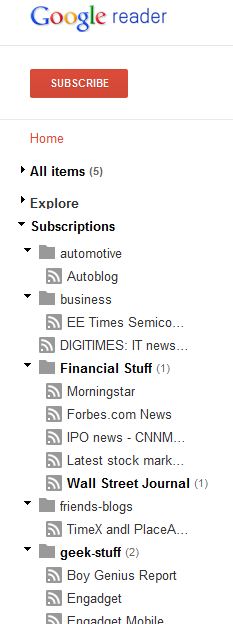


Third, again, color scheme. However, this is sever because it impacts my reading experiences. Take a look at the following picture - I have one unread item, but I cannot distinguish it from the rest because, well the BLACK looks very similar a DARK GRAY (as oppose to blue vs. gray in the previous interface). Seriously Google, are you assuming your customers are all color blinded?!


It's even more sad that I just spend 30min to write my rant. That's because I liked Google's products and enjoyed using them. As Google is turning into a new Microsoft, its arrogant would never allow it to care an end user like me. I lost Google Desktop Search not long ago, and I now just have to start looking for an alternative RSS reader.


Saturday, September 03, 2011

Google, Discontinuing Google Desktop is a Mistake

Among the list of Google products that Google plan to discontinue, Google Desktop is the least I'd see it go. I think Google is making a mistake of discontinuing Google Desktop.

According to Google's blog, below is their reason for discontinuing Google Desktop:

Desktop: In the last few years, there’s been a huge shift from local to cloud-based storage and computing, as well as the integration of search and gadget functionality into most modern operating systems. People now have instant access to their data, whether online or offline. As this was the goal of Google Desktop, the product will be discontinued on September 14, including all the associated APIs, services, plugins, gadgets and support.

I agree that there is a "huge" shift from local to cloud-based storage and computing. However, I think Google over estimated the speed of "cloud adoption" among computer user. I also think Google completely missed the benefit of Google Desktop's potential in Enterprise business.

In the Consumer market, most people store pictures, music and movies in their local hard drives. Picasa does a great job of find and organizing pictures on the hard drive, and most people have a preferred and consistent way of managing their entertainment files - iTune or dedicated folders.

However, in the Enterprise market, people store mostly documents in their local hard drives - things like emails, office documents (World, Excel, PowerPoints) and other proprietary information. For corporate security policy and technology cost reasons, most American corporations have not yet custom the applications of cloud computing. That means either they back up information in company servers, or relying on employees PC hard drives. Finding out a specific piece of information among these files was extremely painful before Google Desktop was available. PC users, which is still the majority of all computer users, should know that Windows' "Find" is almost useless and painfully slow. Windows 7 has made huge improvements on its ability of locating files quickly, but it still lacks the simple and elegant offer from Google Desktop. Similarly, finding a piece of information among the thousands of emails in Outlook is equally bad. Outlook searches by folders instead of the entire email database.

I use Google Desktop on a daily basis. Sometime, I try to find a specific email written or received several quarters back. I remember a few keywords related to the conversation, but I no longer recall the email's subject, and during which time frame I filed that email to a local folder. Using Outlook 2007's search button would sometimes drive me crazy. In these situations, Google Desktop is my time saver. A double-click of Ctrl, and a few seconds later, I can open the email or any related document in its original application (e.g. Outlook or Microsoft Word), and I can resend, attach or continue the topic of discussions very quickly.

First, I don't believe many American corporation would move to cloud computing as quickly. The benefits of cloud computing is very clear, but due to the overall economical situation, IT budget control is a realistic issue. Also, implementing, training and adopting new IT technologies take time. Moving to cloud simply takes time.

Second, cloud computing require network/Internet access. This is a "given" situation among American corporations and consumers, but believe or not, I think it's still a very expensive and luxurious thing in many countries. Countries like Japan or South Korea are the leaders in wireless and wired infrastructure coverage, but other countries like China and India are still far behind. Without sophisticated networking hardware and infrastructure, cloud computing would reduce productivity without effective offline access. Thus, I once argue that there are many corporations and people in the world store information on local hard drives, which could benefit from using a "local" search engine for locating information.

In either way, Google has the right of terminating their product whenever they want to because they were offered free. However, I think there is much more Google can do to improve Google Desktop search. Above all, people still need a "desktop" to access information, regardless where it resides. As for me, I hope to keep using Google Desktop until I no longer can find and download its installation file.

Thursday, August 25, 2011

Acer Chairman is Wrong - Tablet is Here to Stay and Prosper

According to DigiTimes, Acer chairman JT Wang believes "tablet PC fever" is "cool down". When this story was reported by Slashdot, it was called "Acer CEO Declares a Tablets Bubble". I think Acer's chairman is dead wrong.

I talked that HP made a fatal mistake when the company decided to enter the tablet market. The situation is perhaps better in the Android world because most of other tablet OEMs adapt Google's tablet OS. The combined mass creates a comparable Apps developer community to Apple's. However, just because HP decided to quit the tablet market, it does not imply that the consumer no longer need tablets. And certainly, there is no "tablet bubble"!

Looking at Apple's iPad sales in quantity, the numbers grew quarter by quarter and year by year. Apple is projected to sell 30Mu iPad in 2H'11. There are many out there waiting for the iPad 3 coming with higher resolution, from existing iPad and iPad 2 owners, as well as those "I don't have an iPad" consumers. I believe consumers love and want to buy tablets, at the right price and with iPad-comparable performances. The reason I say so is because in the tablet market, there is only one player dominating with huge profits, Apple. That says market demand is larger than supply, and competitions cannot keep up.

Apple basically caught their competitions by surprise. No one knew Apple worked on the product for several years. After iPad was released, Apple's competitors scramble to follow, but they had much less time for both the hardware and software development. In combination, the final products are offered at comparable prices to the iPad, but with sluggish software performance. Just because the PC OEMs cannot compete, it doesn't mean there is a "bubble". Nobody is throwing money away like crazy as in a true "bubble" situation. And for those who can deliver a tablet fitting consumer needs, there is still plenty of money to be made.

I believe in the next a couple of years, we should see strong contenders to Apple's iPad (3?). I think that pack would be led by a Nokia-made tablet running Windows 8 and a Motorola Mobile-made tablet running Android. For the rest, Samsung, hTC, LG, Asus and even Acer, they should either quit tablet and stay with PC, or become much better in their designs. Just don't call it a "bubble".

Saturday, June 06, 2009

Fancy Google Logo


Google's logo just became even more fancy.  Now I couldn't even tell it's "Google".